

The glimpses of ancient animals nowadays are very rare in the wild. But there are some animals which are living on a the planet earth since a long time and are constantly evolving and adapting themselves according to the present day ecosystem. Today we got one of these ancient creatures here, both by looks and name as well as origin. The Komodo dragon, or sometimes called the Komodo monitor is one of those ancient creatures that we can observe and study nowadays. So let's get started.
 |
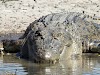
| Varanus komodoensis (Komodo dragon) |
Komodo dragons are, like other reptiles, are cold blooded heavy and big sized lizards which are mainly found on the islands of Indonesia like Rinca and Komodo. These creature usually prefers spending most of their time inside the tropical rain forests of the islands but can also be found wandering around the shore sides of the islands. These large lizards prey on all medium sized and some large sized animals and are very ruthless predators. These animals are known for their big sized body and different kind of venom (which is present in their saliva).
These creature came into existence nearly 4 million years ago. They were first discovered by and studied by western scientists in 1910.
These creatures can live up to 30 years. They are also known by the name of "Komoda monitor". When they were first discovered, they were referred as "land crocodile". Their name, Komodo dragons is given to them as they are native to Komodo islands in Indonesia. In the present time, their population is estimated to be around 6000 distributed around the islands of Komodo, Rinca, Flores and Gili Motang.
Physical Characteristics
Komodo dragons are the largest lizards on the planet. The male komodo dragons can grow up to 8.5 feet (2.6 meters) and can acquire a weight between 174.16 to 200 pounds (79 to 91 Kg) whereas the females can grow up to 7.5 (2.3 meters) feet in length and weigh between 150 to 161 pounds (68 to 73 Kg). In some rare cases, they can also grow more than 10 feet (3 meters) and can weigh more than 300 pounds (~ 136 Kg). Matter of fact, the largest known specimen of komodo dragon is measured to be 10.3 feet (3.14 meters) in length and 366 pounds (166 Kg) weight.

Depending upon the location, they can be black to yellowish-grey in color. Their skin is covered with bony scales called osteoderms. These scales provide protection from scratches or injury on it's body. The skin become hard overtime as a result of competing in fights with other komodo dragons. Speaking of the body, they have a massive body size (for a lizard) with a muscular tail ,strong claws, rounded snouts spread-bowed legs and flat head.
Behavior and lifestyle
These carnivore reptiles are fairly aggressive and can attack if they are spooked or if they smell blood as they have keen sense of smell. They can chase you with the speed of 10 to 13 miles per hour (16 to 20 kmph).The fastest man on the planet Usain bolt was recorded for attaining a speed of 27.8 mph (44.6 Kmph), so you see, you might barely escape after getting chased by a komodo dragon, which is clearly not a good thing to happen. Also if you are wandering that they can climb or not, then you might make a mistake because these creatures can climb the trees with the help of their strong claws and leg muscles despite of their big body structure. Also they can swim with a speed of 6 to 10 mph (9.6 to 16 Kmph). Therefore the conclusion is, do not get fooled by their big body or their lazy ass looks because they can chase you almost everywhere.

- Komodo dragons are the biggest specie of lizard found on this planet.
- They are purely carnivores in terms of food consumptions.
- They have thick and hard skin to provide protection against injuries.
- They are quite good runners, swimmers and climbers.
- They can asexually reproduce with the help of a process called "Parthenogensis".
- They have venomous bite.
- They have powerful immune system but slow metabolism.
- Although their mouth is contains several bacteria, they are surely look after there mouth's hygiene by licking there lips and sometimes dipping their mouth in water to get rid of the extra flesh remaining in their mouth.
- In native areas like Komodo islands they are also referred as "oras" which means land crocodile.
- They can consume up to 80% of their total body weight.
- Despite being native to Indonesian islands like Komodo, they actually came from Australia (as their origin).
- They can take down a big sized animal like a wilder beast or a buffalo.
- They have a sharp and keen sense of smell.
- They can smell a dead flesh from nearly 5 miles away (8 Km).
- They rub their body on feces, rotten flesh or poop and sometimes climb a tree to avoid getting eaten by other animals or by their own kind.
- Being a dominant and ferocious predator in their ecosystem, they can also be quite playful if they are treated with proper care in captivity, away from all the dangers.



0 Comments
Please do not abuse or post any spam link in the comment section. Thank You.